Industrial Safety Gloves

Leather Safety Gloves

Best Leather Safety Gloves

The Best Leather Gloves

FREE SHIPPING

ORDERS OVER $200

QUICK PAYMENT

FULL SECURE PAYMENT

CERTIFIED PRODUCTS

CERTIFIED QUALITY

Know the story behind the quality of the Colombian leather safety glove. Since long before the Spanish colonization, many people in Colombia already dominated the activity of modifying leather for their own use, these were extracted from animals typical of the South American fauna, their great creativity and ingenuity turned the skin of the animals into protective layers of the cold. To prevent the leather from hardening, these men used animal fat from the slaughter itself, smearing it all over their chosen hide, to keep the leather useful and intact. This simple task, which for them served mainly as a means of survival, would cement the basis of what would become one of the first artisan traditions in Colombia.

By the middle of the 20th century, the Colombian leather industry had become a mature and stable sector.

Currently, Colombia is a very livestock country, whose culture has spread throughout practically the entire country, due to this livestock culture and years and years of leather handling, Colombia has managed to position itself as an exporter of high quality leather. Colombia currently produces leather that is in great demand in the international market, from the United States to Australia.The leather export sector in Colombia is growing by leaps and bounds and now the list of importing countries of Colombian leather has been extended, countries such as Panama, Mexico, South Korea and Japan

are already part of the largest importers of Colombian leather and have nothing To envy countries like France or Italy when it comes to nationally made leather pieces.

However, this growth has not been easy. Already in 2018, Colombia entered the top 3 of Latin American countries that dominate the leather goods market, preceded by Brazil and Mexico.

The industry of industrial safety articles has not been alien to the leather manufacturing sector and a specialized line has been created to manufacture products that withstand the strong and hard industrial activity while maintaining the comfort and softness of leather, which is why today the country can offer leather safety gloves made from 100% Colombian leather.

Many international brands have started working with Colombian leather and entrepreneurs are creating innovative startups to take advantage of the quality and name of leather to export their products.People don’t seem to have enough. Unlike most materials, leather does not age and does not deteriorate on its own. The only reason someone would throw away a leather item is because they are bored with it, and with pieces made in Colombia, this will not be the case.

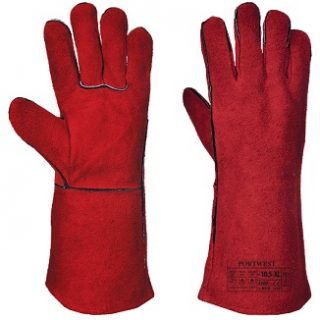
Safety Leather Gloves

Short Leather Reinforced Cowhide Glove

  • Material: Gloves made of cowhide leather caliber 2.4 mm. According to NTC E-79 standards and sewn with threads as indicated in the NTC-1981 standard.
  • Shape: The gloves have a wide opening that allows easy donning and doffing. They have good flexibility so that the worker has the possibility of handling small and delicate objects as well as large and heavy objects with them.
  • Requirements: The gloves comply with what is stipulated in table 1 of Icontec No. 2190 standards on dimensions and the reinforcements comply with those given in table 2 of said standard.
  • Technical Specifications: They are sewn with 100% cotton thread and the seams are uniform without loose threads. They are wide, flexible, easy to handle, easy to place in the hands, in general they do not present folds or folds that bother the user.

Engineer Glove In Cowhide Leather Simple

  • Made of caliber 2.4 mm cowhide leather according to NTC E79 standards and sewn with 100% cotton threads as indicated in the NTC 1981 standard. They comply with the provisions of table 1 of the Icontec 2190 standards on dimensions.
  • Wide opening that allows the user to put them on and take them off easily.
  • Good flexibility so that the user has the possibility to manipulate small and delicate objects, as well as large and heavy objects with them.
  • Uniform seams without loose threads.
  • They do not present folds or gathers in the material that can make the user uncomfortable.
  • Elastic binding on the wrist.

Long Reinforced Cowhide Glove

  • Material: Gloves made of cowhide leather caliber 2.4 mm. According to NTC E-79 standards and sewn with threads as indicated in the NTC-1981 standard.
  • Shape: The gloves have a wide opening that allows easy donning and doffing. They have good flexibility so that the worker has the possibility of handling small and delicate objects as well as large and heavy objects with them. Length of 7″
  • Requirements: The gloves comply with what is stipulated in table 1 of Icontec No. 2190 standards on dimensions and the reinforcements comply with those given in table 2 of said standard.
  • Technical Specifications: They are sewn with 100% cotton thread and the seams are uniform without loose threads. They are wide, flexible, easy to handle, easy to place in the hands, in general they do not present folds or folds that bother the user.

Safety Gloves in US

Standard of safety gloves

Safety gloves at work are mandatory to take care of our hands, there are several types of gloves which are selected according to the activity and the risks of an accident. Safety gloves must comply with international standards that specify what type of activity they are used for and what requirements they must withstand.

ANSI/ISEA 105
American National Standard for Hand Protection
This standard addresses the classification and testing of hand protection for specific performance properties related to chemical and industrial applications. Hand protection includes gloves, mittens, partial gloves, or other items covering the hand or a portion of the hand that are intended to provide protection against or resistance to a specific hazard.

Mechanical Protection. Cut Resistance
The new ASTM F2992-15 test replaces ASTM F1790-05 and ensures uniform testing plus increases the performance levels beyond the old level 5. The sample is cut 15 times by a straight edge blade, under load. A new blade is used for each cut. The data is then used to determine the required load to cut through the material and this in turns is equated to a cut level. The new levels are now prefixed with the letter A.

Puncture Resistance
When tested in accordance with Clause 6.4 of EN 388:2003 Protective gloves against mechanical risks, the gloves resistance against puncture shall be classified against the levels listed in Table 2, using the puncture force. The average of a minimum of 12 specimens shall be used to report the classification level.

Abrasion Resistance
When tested in accordance with ASTM D3389-05, Standard Test Method for Coated Fabrics Abrasion Resistance or ASTM D3884-09, Standard Guide for Abrasion Resistance of Textile Fabrics (Rotary Platform, Double-Head Method). These test methods shall be followed using H-18
abrasion wheels with a 500 gram load for levels 0 to 3 and a 1000 gramme load for levels 4 to 6. Using ASTM D3389-05 for coated glove fabrics or unsupported gloves, the end point at which the glove material is determined to fail shall be at the number of abrasion cycles just before the film or coating has a hole abraded through it. Using ASTM D3884-05 for coated glove fabrics, the end point shall be when the first thread or yarn is broken. The average of a minimum of 5 specimens shall be used to report the classification level.

Chemical Protection. Chemical Permeation Resistance
When tested in accordance with ASTM F739-07, Standard Test Method for Permeation of Liquids and Gases through Protective Clothing Materials under Conditions of Continuous Contact the gloves chemical permeation shall be classified against the levels listed in Table 4 using the average standard breakthrough time (for each chemical tested). The average of a minimum of 3 specimens shall be used to report the classification level. In reporting permeation data for each chemical the permeation rate shall be reported in μg/cm2 min. It shall be permitted to report the cumulative permeation in g/cm2 that occurs within 1 hour of the test for each chemical.

Clasification for ignition resistance and burning resistanceHeat and Flame Protection. Ignition Resistance and Burning Behavior (or After Flame Time)
When tested in accordance with ASTM F1358-08, Test Method for Effects of Flame Impingement on Materials Used in Protective Clothing Not Designated Primarily for Flame Protection, the glove materials ignition resistance and burning behavior shall be classified against the levels listed in Table 6, using ignition time and burn time. In order to be classified at a specific level, the glove material shall meet each of the criteria at that specific level. The average of a minimum of 3 specimens shall be used to report the classification level.

ANSI/ISEA-138
American National Standard for Performance and Classification for Impact-Resistant Gloves (ANSI/ISEA 138-2019) This new standard provides an improved method of classifying impact protection to the back of the hand. The test is conducted by dropping a 5-joule mass on the impact points of the glove, recording the force transferred in kilonewtons (kN). This test is repeated eight times for the knuckles and ten times for the fingers. Gloves are classified based on test result average of the tests conducted. To classify as an ANSI/ISEA 138 level 1, 2, or 3, the average and all test results must be within the classification parameters.

Test Method For Determining Arc Ratings of hand protective productsASTM F2675-13 Test Method For Determining Arc Ratings of Hand Protective Products Developed and Used for Electrical Arc Flash Protection.
This test method is used to measure and describe the properties of hand protective products in response to convective and radiant energy generated by an electric arc under controlled laboratory conditions. There are 4 levels in the Hazard Risk Category rated by the ATPV (Arc Thermal Performance Value).